
England
& Wales Hardwicke Marriage Index
Marriages
1754 - 1837
Aylsham St Michael
| |
England
& Wales Hardwicke Marriage Index |
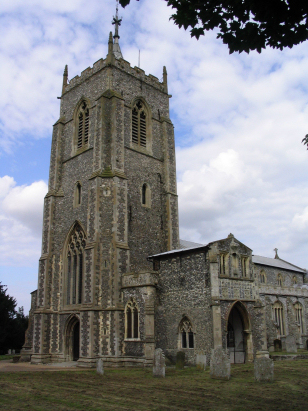
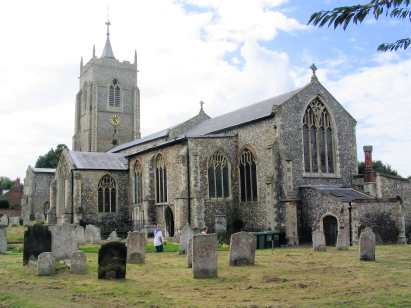
The ParishThe parish of Aylsham lies in northeastern Norfolk roughly 12 miles north of the city of Norwich. Aylsham formerly sat on the course of the A140 road connecting Norwich with the coastal resort of Cromer but thankfully that road now bypasses to Aylsham's east. Aylsham is a market town, it was first granted in 1296, a regional centre for trade and specialist skills and previously a stronghold for weaving. The initial prosperity of the town came from the manufacture of linen, so well-known they acquired the name "Aylsham Web", as this trade lapsed in the 15th century it became noted for the weaving of wool for worsted cloth. Like most of Norfolk's rural parishes the wider portion of Aylsham parish would have also been arable with early gazetteers estimate over 80% of the parish acreage as arable. The mechanisation of northern mill-towns in the industrial revolution saw Aylsham's weaving trade collapse like the remainder of its county and the town became merely a market. Attempts were made to boost income by the canalisation of the River Bure, on which it sits, such that vessels up to 40 tons burden could arrive from Great Yarmouth, that has now lapsed. The other modernisation of the town arrived with 2 lines belonging to the Midland & Great Northern Railway connecting Aylsham with Wroxham, North Walsham, Reepham and their main junction and depot at Melton Constable, all sadly close nowadays except for the line from Wroxham not the course of a miniature heritage steam line. To replace the lost industry there is only a small industrial estate but the town retains its central market place and most of its specialist and essential shops and inns. In modern times commuter development and modern estates have expanded its footprint such that it now covers an oval of land 2 miles from north to south and a mile from east to west. Aylsham is drained southeastwards by the River Bure, one of Broadland's major rivers, it makes its own way across the Norfolk Broads and arrives independently into Great Yarmouth east of Breydon Water and thence to the North Sea. Aylsham is sited mostly on the southwestern slopes of the Bure's valley rising from 10 metres at the river to 30 metres in its higher suburbs, the landscape is rather gentle rising westwards to just reach the 50 metres contour in a few spots. Aylsham parish was a giant in Broadland terms, swamping the local network of tiny parishes, it covered just over 4,300 acres and would have supported a population of around 2,450 parishioners. Already by Domesday times Aylsham was large enough to sit within the top 20% of settlements by population in the land; held directly by King William it was a very wealthy manor offering an impressive 31 ploughs, meadows & woodland no fewer than 4 mills. |
 |
|
|
|
| Register No | Covering Dates | Deposited With | Register Style | Quality Standard | Comments |
| 1 |
15th July 1754 - 6th March 1780 |
Norfolk Record Office - Reference - PD602/7 |
Standard preprinted and self-numbered Marriage register
with 3 entries per page |
Grade 3 Register - there are sufficient quality issues with this register to indicate that some misreads will occur albeit few in number | Poor handwriting throughout this register may result in a
few misreads |
| 2 | 5th April 1780 - 31st December 1812 | Norfolk Record Office - Reference - PD602/8 | Standard preprinted and self-numbered Marriage register with 4 entries per page | Grade 3 Register - there are sufficient quality issues with this
register to indicate that some misreads will occur albeit few in
number |
Poor handwriting throughout this register may result in a few
misreads |
| 3 | 26th January 1813 - 21st June 1837 | Norfolk Record Office - Reference - PD602/9 | Standard Rose style preprinted and prenumbered Marriage register | Grade 2 Register - not a perfect read but with a low likelihood of
misreads |
None |
|
Oulton
St Peter & St Paul
|
Banningham
St Botolph
|
|
|
Cawston
St Agnes
|
 |
|
|
Cawston
St Agnes
|
Brampton
St Peter
|
1760 1770 1780 1790 1800 1810 1820 1830
Corrections to Tinstaafl Transcripts